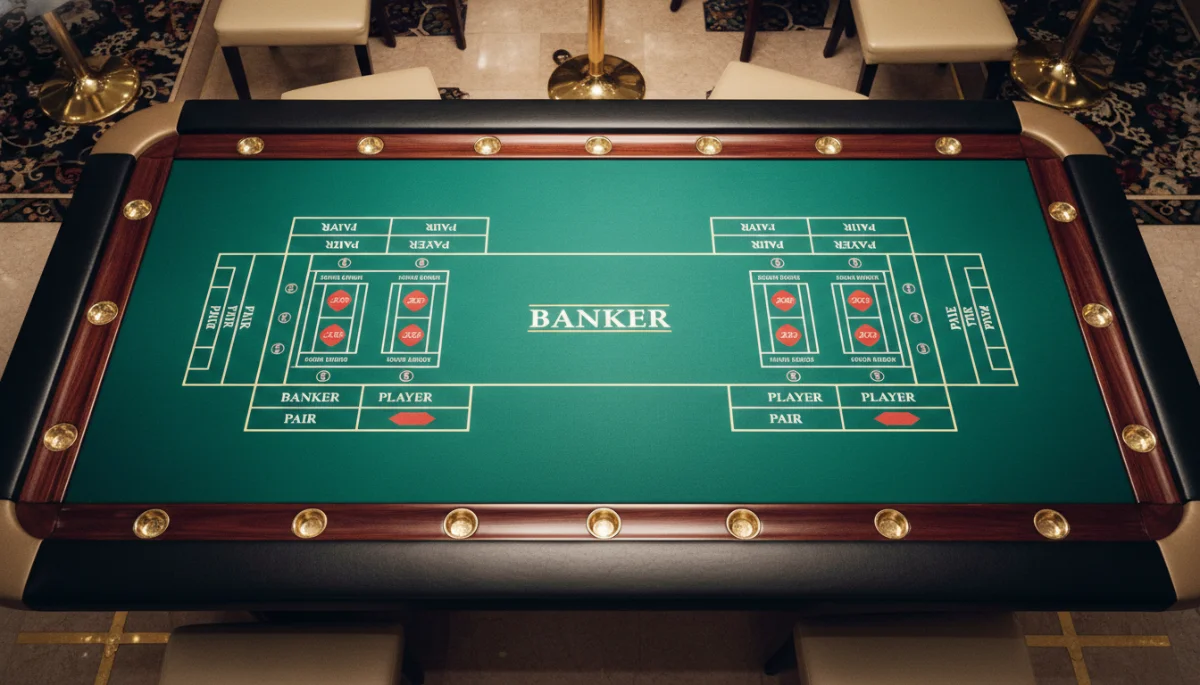
The Illusion of Predictability
Baccarat occupies a peculiar place in the casino world. Unlike blackjack, where basic strategy matters, or poker, where skill influences outcomes, baccarat appears deceptively simple yet captivates players with an elaborate infrastructure of tracking tools. Walk past any high-limit baccarat table and you’ll see scorecards, electronic displays showing the big road, derived roads, and other tracking systems all designed to reveal hidden patterns in the sequence of results. The premise underlying all this activity is straightforward: if you can identify a pattern in past outcomes, you can predict future ones. This premise is also entirely false.
The baccarat pattern spotting myth persists because it feels logical. After all, casinos themselves provide the tracking displays. Electronic boards prominently display recent results in multiple formats. Online platforms replicate these same visual systems in their live dealer environments. To the casual observer, this infrastructure suggests there must be something meaningful to track. What it actually demonstrates is that casinos understand human psychology better than most humans understand themselves.
How Pattern Tracking Works in Baccarat
Baccarat tracking systems come in several varieties, each reformatting the same raw data—sequences of Banker, Player, and Tie results—into different visual structures. The bead plate shows results as a grid of coloured beads. The big road condenses consecutive wins into vertical columns. The big eye boy and small road, known as derived roads, examine the big road itself for patterns of repetition or alternation. To someone unfamiliar with probability, these displays appear sophisticated. To anyone trained in mathematics, they are simply historical records dressed up to feel predictive.
The psychological appeal is undeniable. These tools give players the sense they are engaged in genuine analysis. They provide something to focus on, a framework for decision-making, and a reason to stay at the table longer. This engagement increases the volume of bets placed and the time spent gambling. From the casino’s perspective, the tracking displays achieve their actual purpose perfectly.
The Mathematics That Contradicts the Myth
Each hand of baccarat resolves with probabilities that remain constant regardless of what has come before. In a standard six or eight deck shoe, the Banker outcome occurs at approximately 45.86 percent, the Player outcome at 44.62 percent, and a Tie at 9.52 percent. These figures hold whether the previous hand was Banker, whether the previous ten hands were Banker, or whether an entire shoe showed nothing but Banker results.
This consistency reflects a fundamental principle of probability: independence. The cards removed in previous hands no longer affect the composition of the remaining shoe in any meaningful way. Yes, technically the shoe composition shifts with each hand, but the effect is negligible—far too small to exploit through ordinary play. A shoe containing 312 cards has seen perhaps 50 hands played. The removal of 100 cards does not materially alter the probabilities for the 51st hand.
A streak of ten consecutive Banker results does not increase the likelihood that Player will win next. The outcome of hand 51 has no awareness of outcomes 41 through 50. This is where most players experience cognitive friction. The brain recognises the streak as statistically unusual and expects the universe to correct this imbalance by producing the opposite result. The universe operates under no such obligation. This expectation is the gambler’s fallacy in its purest form.
Why Human Cognition Fails at Randomness
Understanding why people fall for the baccarat pattern spotting myth requires understanding something about evolutionary psychology. The human brain evolved to detect patterns because this ability conferred survival advantages. Recognising predators in tall grass, understanding seasonal food sources, and identifying allies versus threats all depended on pattern recognition. The cost of false positives was usually low. The cost of false negatives could be fatal.
This evolutionary heritage means the modern human brain is heavily biased toward finding structure in random data. Behavioural economics research consistently demonstrates that people misjudge what randomness actually looks like. Truly random sequences contain far more clumping, clustering, and apparent patterns than intuition suggests. When a player observes five consecutive Banker results, the brain categorises this as meaningful information rather than recognising it as a perfectly normal outcome within random distribution.
This bias does not disappear through intellectual awareness. A mathematician observing a baccarat table experiences the same cognitive pull toward pattern-finding as anyone else, even while consciously knowing the patterns have no predictive value. The feeling that a streak is “due” for correction is not an error in logic—it’s an automatic mental process that runs beneath conscious reasoning.
Popular Systems and Their Fatal Flaw
Several betting strategies dominate baccarat culture, and all share the same foundational error. The Martingale system instructs players to double their bet after each loss, based on the assumption that a win is overdue after a losing streak. The Paroli system reverses this logic by doubling after wins, based on the assumption that streaks tend to continue. Trend-following systems instruct players to bet with the streak. Trend-reversal systems instruct them to bet against it.
What these strategies share is the belief that past outcomes influence future ones in a way that can be exploited. They do not. Each hand still resolves at those fixed probabilities. Progressive betting systems can generate short-term wins because variance allows for winning runs, but over sufficient hands the house edge reasserts itself with mathematical certainty. A finite bankroll facing an infinite series of negative expected value outcomes has only one possible conclusion.
What Actually Shapes Your Results
Recognising the pattern spotting myth for what it is creates space for more grounded decision-making. The genuine strategic considerations in baccarat are limited and well-established. The Banker bet carries the lowest house edge at approximately 1.06 percent after accounting for the standard 5 percent commission on winnings. The Player bet follows at around 1.24 percent. The Tie bet, despite its appealing 8 to 1 payout, carries a house edge of roughly 14.36 percent and should be understood as pure entertainment spending.
The other lever under player control is bankroll management. Setting a session budget, defining a loss threshold, avoiding bet escalation following losses, and maintaining the perspective that baccarat is entertainment with a cost rather than an income source are the practical habits that separate disciplined players from those who lose more than intended. These factors have nothing to do with pattern spotting and everything to do with personal discipline.
Baccarat Without the Fiction
Baccarat remains an elegant game. The pace is measured, the decisions are straightforward, and a well-managed table possesses a charm few other casino games can match. None of this elegance depends on pattern spotting being real. In fact, players who abandon the search for predictive patterns frequently discover the game becomes more enjoyable, not less. The pressure to decode a sequence that cannot be decoded gives way to genuine appreciation for the game itself.
The cards hold no memory. The shoe owes no one a corrective streak. The big road displays historical fact, not future forecast. Understanding these realities does not diminish baccarat—it simply repositions the player in a more honest relationship with the game, where decisions rest on probability and personal limits rather than the comfortable fiction of patterns that were never truly present.