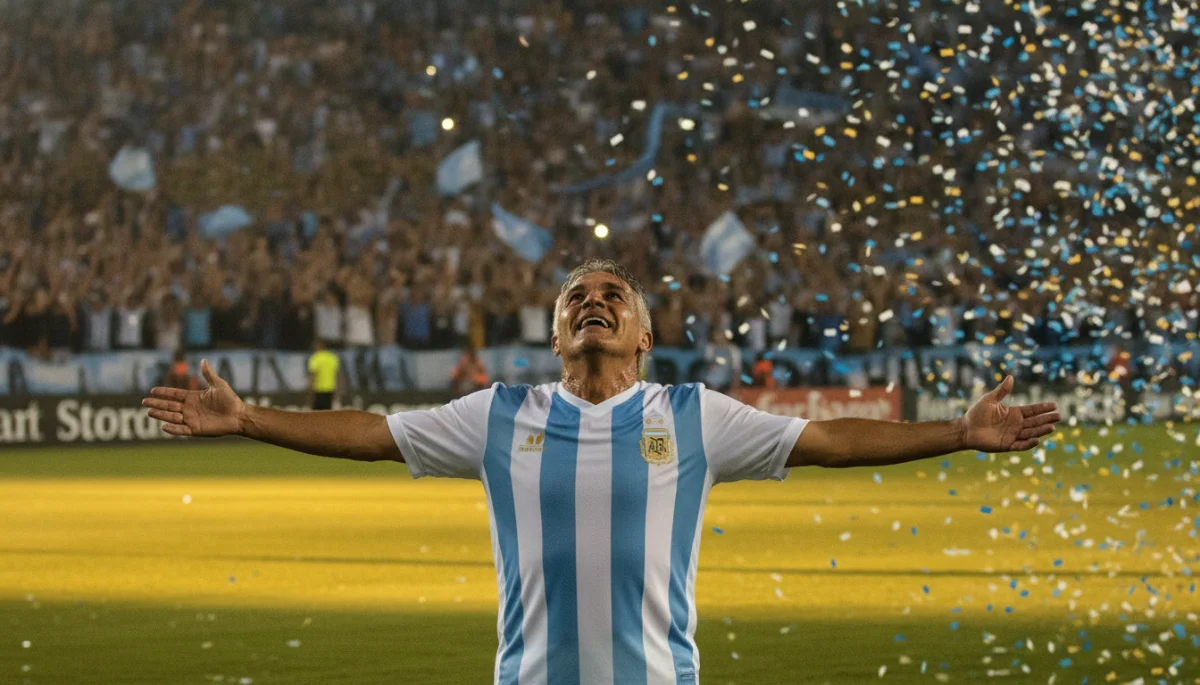
In the rare moments where sport transcends mere competition, statistics become poetry rather than numbers. At 38 years old, Lionel Messi has reached that transcendent point during the 2026 FIFA World Cup, and the entire world has paused to witness his impossible journey. Just last Monday in Arlington, Texas, Messi scored his 17th and 18th World Cup goals, officially becoming the all-time leading scorer in FIFA World Cup history. This achievement places him not just ahead of men, but ahead of every player who has ever competed in the tournament, male or female.
His performance against Austria was nothing short of legendary. After missing a penalty kick early in the match—a rare stumble for one of soccer’s greatest finishers—Messi bounced back with incredible resilience. He curled a laser shot into the net at the 37:39 mark to break the scoreless tie, then added a scrappy, determined rebound goal deep in stoppage time. These two goals moved him past Germany’s Miroslav Klose, who held the record with 16 goals, and also surpassed Brazil’s women’s icon Marta. Messi now stands alone in territory that no player has ever occupied before.
The Road to an Unbreakable Record
What makes this achievement even more remarkable is the context of Messi’s career. His first World Cup goal came on June 16, 2006, when he was just 18 years old, scoring against Serbia and Montenegro. Twenty years later, at 38 years and 357 days, he has become the oldest player to score a hat-trick in World Cup history. His legendary treble against Algeria in Argentina’s tournament opener was his first hat-trick at a World Cup and tied Klose’s long-standing record of 16 goals.
Six days later, against Austria, Messi entered the match with 16 goals and quickly added two more. The miss on the penalty kick only made his subsequent goals more dramatic. His cutback finish in the 38th minute and his late second goal secured a 2-0 victory, bringing his all-time total to 18. In just two games, he scored five goals. Across six different World Cup editions, he has now accumulated 18 goals, making him the first player ever to feature in six men’s World Cups.
What This Means for Soccer History
Messi’s accomplishment redefines what is possible in professional athletics. He is now the second man in World Cup history to score four or more goals in three different editions of the tournament, following Miroslav Klose’s performance in 2002, 2006, and 2010. Remarkably, he has also joined Roger Milla as the only male players to score four or more goals in a single World Cup while aged 38 or older. His teammates have been left speechless by his dominance. After the Austria win, midfielder Alexis Mac Allister stated that anyone who thought Argentina was better off without Leo now understands that Messi is the most important player in the squad.
While Messi currently holds the record, it may not remain safe for long. Kylian Mbappé sits second all-time with 16 career World Cup goals, just two behind Messi’s 18. The French captain is still very much in the tournament, and with France looking like genuine contenders for the title, the gap could narrow quickly. However, for now, Messi leads the pack, and the question remains how many more goals he can add before his final World Cup concludes.
Why Global Fans Should Watch
Beyond the sheer spectacle of Messi’s performance, there is a practical reason for soccer fans worldwide to pay close attention to his form. Argentina, the defending world champions, has won all their group matches and conceded zero goals, making them the team to beat. If any nation, including potential opponents like Canada, navigates through the round of 32 and beyond, they could face Messi and Argentina in the later stages of the tournament. Understanding what they are facing—a 38-year-old playing the soccer of his life, surrounded by world-class talent—is not just interesting but essential.
Fans can watch Argentina’s next match against Jordan tonight at 10 p.m. ET on TSN. Messi will almost certainly be on the pitch, and if recent form serves as any guide, history may be made again. This is the greatest show on earth, and Lionel Messi is rewriting the world’s most sacred sporting record at an age when most athletes have already retired.