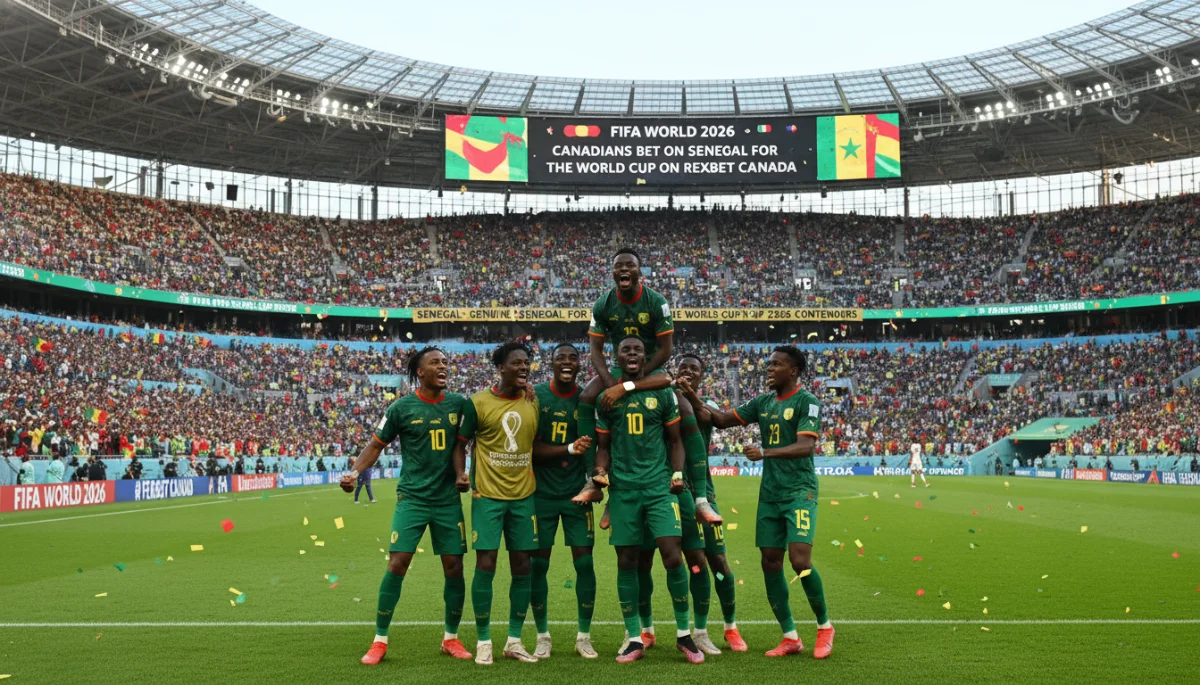
Senegal enters the 2026 FIFA World Cup with real ambition, not polite hope. Head coach Pape Thiaw has made that clear by saying he would step aside if he doubted he could win the tournament with this squad.
That confidence reflects how far the Lions of Teranga have come. Senegal are no longer treated as a feel-good outsider; they are viewed as one of Africa’s most complete teams, with the kind of balance that makes them dangerous in a knockout setting. For fans and bettors who follow long-shot contenders with genuine upside, the Senegal World Cup 2026 outlook looks stronger than it has in years. Canadian bettors can also follow that market through Rexbet Canada, where Senegal’s blend of veterans and rising talent makes them an intriguing option.

What makes Senegal so compelling is that their success is built on two realities at once. On the field, they have produced elite international quality. Off the field, the system behind that success has often left local institutions with very little reward. The same pipeline that powers the national team also exposes deep inequalities in how football wealth is distributed.
A Talent Factory That Does Not Pay Evenly
Senegal, a country of roughly 20 million people, produces an extraordinary amount of top-level football talent. That output is driven by academies such as Generation Foot, Diambars, and Dakar Sacre Coeur, which combine training, schooling, and medical support in a way that can prepare teenagers for elite European football.
The model works well for players and for the foreign clubs that sign them, but it is much less generous to the local game. Long-term ties between Senegalese academies and European teams give overseas clubs first access to the best prospects. FC Metz’s relationship with Generation Foot is a classic example, and it helped launch careers like Sadio Mane’s, along with those of Ismaila Sarr and Pape Matar Sarr.
The financial return, however, has been painfully uneven. In one recent review of 13 academy-developed players selected for Senegal’s continental squads, the local academies received only €100,000 in initial transfer fees. Those same players were later sold onward for a combined €81.2 million, and their total career transfer value has crossed €411 million. The numbers tell a blunt story: Senegal develops the talent, but much of the money is earned elsewhere.
That imbalance has consequences at home. Domestic clubs struggle to modernize facilities, stadiums deteriorate, and the local league remains overshadowed by the export market. In some cases, clubs have even had to push the federation to recover FIFA solidarity payments they are owed after major transfers, including Nicolas Jackson’s move to Chelsea.
Building Power Through the Diaspora
Senegal’s rise has not come from local development alone. The federation has also become highly effective at persuading diaspora players to represent the country before they commit to another national team.
The strategy is simple but disciplined. Senegal identifies promising dual nationals in Western Europe at a young age, usually between 16 and 19, then builds a case around identity, belonging, and opportunity. The approach has worked especially well because the team is winning, the project feels credible, and the emotional pull of Senegal remains strong in many families abroad.
Recent examples include Ibrahim Mbaye of PSG and Mamadou Sarr of Chelsea, both of whom previously played for France at youth level. Their decisions show how much Senegal’s recruitment machine has improved. The federation no longer waits for talent to drift toward it; it moves early and with purpose.
Why the approach matters
- It expands the talent pool beyond the domestic league.
- It helps Senegal compete with larger European federations for elite prospects.
- It keeps the national team younger, deeper, and more adaptable.
- It also adds pressure to deliver results quickly, because the project is now being judged at the highest level.
A Squad Built for a Final Push
The current Senegal side is defined by contrast. Veteran leaders like Idrissa Gana Gueye can share the pitch with teenagers who are still developing in Europe’s biggest academies and clubs. That mix gives the team experience, energy, and tactical flexibility.
For the country’s biggest names, 2026 may be the last realistic chance to define an era. Sadio Mane, Kalidou Koulibaly, and Edouard Mendy have already shaped Senegal’s modern identity, but a World Cup run in North America could give that generation its defining achievement.
The group-stage challenge is severe. Senegal sit in a demanding Group I with France, Norway, and Iraq, and their first match against France in New Jersey will immediately test how far they have come. If they survive that opening stretch, they will have the physical strength, defensive structure, and depth to trouble almost anyone in the bracket.
That is the contradiction at the heart of Senegal’s rise. The team looks ready for a serious World Cup run, yet the system that created it still leaves too many local foundations under strain. Senegal may be prepared for glory, but the broader football economy around it still needs repair.