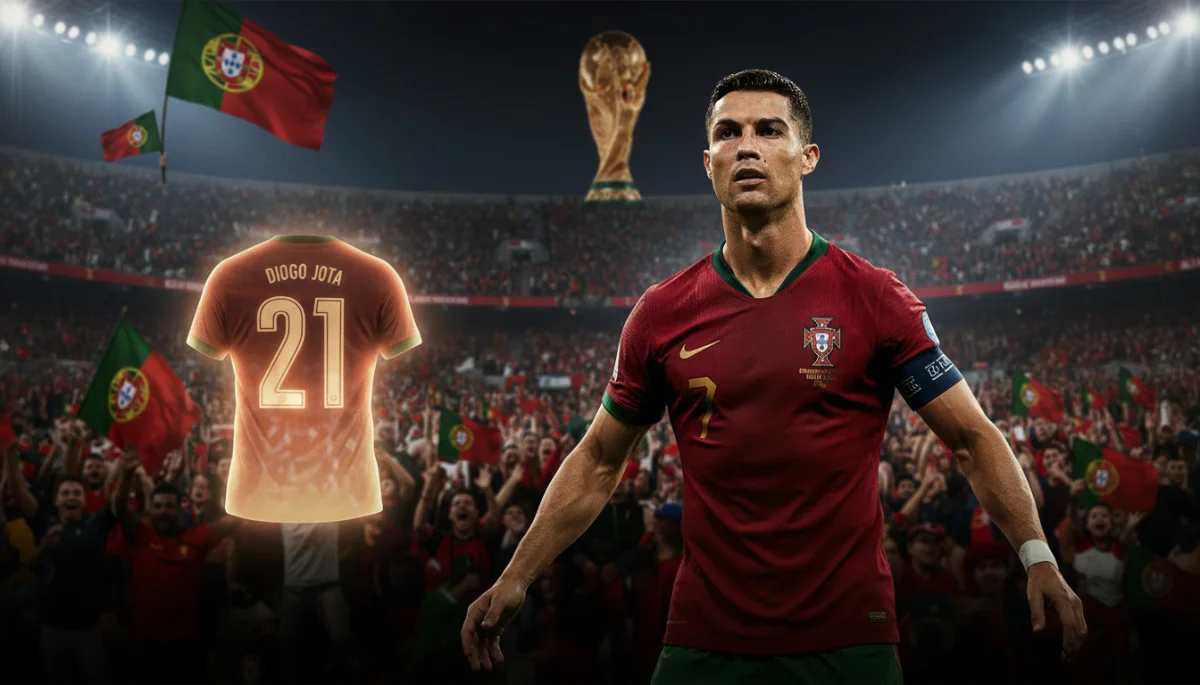
Portugal has named a World Cup squad that blends star power, depth, and heavy emotion. Cristiano Ronaldo is in the group once again, and at 41 he is set to chase one more historic milestone on the biggest stage in international soccer. At the same time, the team is carrying the memory of Diogo Jota, whose absence will be felt far beyond the lineup sheet.
Head coach Roberto Martínez made clear that this is more than a routine squad announcement. It is a statement of ambition, but also a tribute to a player who meant a great deal to the national team. With Ronaldo still central to the project and Jota honored as a lasting part of the journey, Portugal’s campaign already has a powerful emotional edge.
Ronaldo’s sixth tournament is within reach
Ronaldo remains the biggest name in the Portugal setup. If he appears in this tournament, he will become one of the first male players to take part in six World Cups, a milestone that would add yet another line to a career already packed with records.
That pursuit matters because it reflects how long he has stayed at the top. Even now, Martínez values him not just as a finisher, but as a leader whose standards shape the rest of the squad. In a tournament where experience often separates contenders from the rest, Ronaldo’s presence still changes the way Portugal is viewed.
- Most goals in men’s international soccer
- Most appearances in men’s international soccer
- Only male player to score in five different World Cups
- One of the defining figures in Portugal’s modern era
Ronaldo’s legacy is already secure, but the chance to keep competing at this level gives Portugal both a technical weapon and a symbolic one. For teammates, that matters nearly as much as his scoring touch.
A squad built for balance and flexibility
Portugal’s roster is deep enough to adapt to different opponents and match situations. Martínez has mixed established leaders with younger players who bring energy, movement, and tactical versatility. That combination makes Portugal one of the more difficult teams to plan against.
The group also reflects the strength of Portuguese talent across Europe. Several players come from major clubs, while Ronaldo and João Félix are both with Al Nassr, giving the squad a mix of familiar partnerships and top-level experience.
Goalkeepers and defenders
The defensive unit starts with a reliable goalkeeper group and a back line that can both absorb pressure and start attacks. Portugal’s goalkeepers are:
- Diogo Costa
- José Sá
- Rui Silva
- Ricardo Velho
Ricardo Velho is included as a fourth option and would likely only become relevant if injuries or other absences force a change. That kind of depth gives the staff peace of mind during a long tournament.
In front of them, Portugal has a defense that combines control and athleticism. Rúben Dias stands out as the anchor, while João Cancelo, Diogo Dalot, and Nuno Mendes can push high and create width from full back. The remaining defensive options add rotation, cover, and different tactical profiles.
- Rúben Dias
- João Cancelo
- Diogo Dalot
- Nuno Mendes
- Nélson Semedo
- Matheus Nunes
- Gonçalo Inácio
- Renato Veiga
- Tomás Araújo
Midfield creativity and attacking options
Portugal’s midfield is one of its strongest areas. Bruno Fernandes and Bernardo Silva bring proven creativity, while Vitinha and João Neves offer control, press resistance, and the ability to keep the team moving at a high tempo. Rúben Neves and Samú Costa add further balance and coverage.
- Bruno Fernandes
- Bernardo Silva
- Vitinha
- João Neves
- Rúben Neves
- Samú Costa
The front line may be the most exciting part of the squad. Portugal can lean on Ronaldo as a central reference point, but it also has pace and directness on the wings. Rafael Leão, Pedro Neto, Francisco Conceição, and Francisco Trincão can all stretch defenses, while Gonçalo Ramos and João Félix give Martínez different ways to build attacks.
- Cristiano Ronaldo
- Rafael Leão
- João Félix
- Gonçalo Ramos
- Pedro Neto
- Francisco Conceição
- Gonçalo Guedes
- Francisco Trincão
That variety matters because Portugal will not need to play the same way in every match. It can attack through the middle, break quickly from wide areas, or build around a target forward depending on the opponent.
Group stage tests and preparation schedule
Portugal has been placed in Group K alongside Congo, Uzbekistan, and Colombia. It is a group that should still demand focus, especially because the opening match can set the tone for the rest of the campaign.
The team will begin preparations on June 1, then use a short series of warm-up matches before heading to the United States. The schedule looks like this:
- Portugal vs. Chile — June 6
- Portugal vs. Nigeria — June 10
- Travel to the United States — June 12
- Portugal vs. Congo — June 17
Portugal opens its tournament against Congo in Houston on June 17. Those early fixtures should help Martínez settle on a preferred starting XI and test how well the squad’s different pieces fit together under real pressure.
Why belief around Portugal is growing
Martínez has resisted calling Portugal the outright favorite, suggesting that label belongs to nations with a World Cup title already on the shelf. Even so, there are strong reasons to believe this team can make a serious run.
Portugal’s recent success is one of them. Winning the 2025 Nations League by beating Germany in the semifinal and Spain in the final showed that this squad can handle elite competition. That kind of result changes expectations, especially for a country that has never won the World Cup.
Portugal enters the tournament with a rare mix of experience, technical quality, and emotional purpose. That combination can be dangerous when the matches start to tighten up.
There is also the human side of the story. Diogo Jota’s memory gives the squad an emotional drive that cannot be measured on a stat sheet. Martínez described him as Portugal’s “plus one forever,” and that message will stay with the group throughout the tournament.
A team chasing more than results
Portugal is chasing its first World Cup title, but the stakes feel even larger than that. For Ronaldo, it may be the final chapter of a remarkable international career. For Martínez, it is a chance to prove that this generation can go all the way. For the rest of the squad, it is an opportunity to turn talent into history.
If Portugal finds the right balance between control, speed, and defensive discipline, it can challenge anyone in the field. And with Ronaldo leading the way and Jota remembered in every step, this World Cup campaign already feels like one of the most meaningful in the nation’s history.